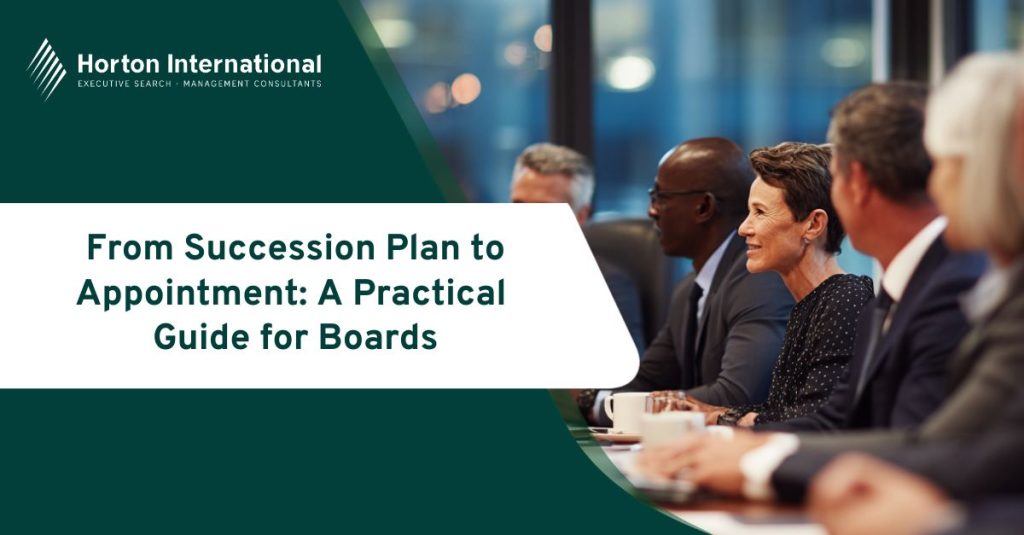

Having a robust CEO succession plan in place is now a baseline expectation of good governance – but the uncomfortable truth is that many boards still falter when moving from plan to execution.
The succession plan to appointment journey is where theory and preparation meets real-world pressure head on, when this happens even experienced boards can lose control at the wheel. Having a good strategy in place to keep track of process, pace, and outcomes will enable the business to make the transition seamlessly, without incurring negative impacts.
There is good news on the horizon – some organisations have already successfully encouraged their boards to become more fully involved in the CEO succession journey. This is a timely shift, research from The Conference Board showed that CEO succession announcements in the S&P 500 were projected to reach 13% in 2025, up from 10% in 2024, demonstrating that in recent years there’s been an uptick in active board intervention rather than crisis response.
Companies who fully engage the board in this process will be the types of organisations that are well-positioned to thrive going forward – and to follow in their footsteps, there are a number of practical, actionable steps companies can follow. By taking an end-to-end view of the CEO appointment process, leaders will be able to fully integrate the board, allowing it to move swiftly, with clarity, discipline, and confidence.
Why the gap between having a plan and executing it well is where most boards will struggle
Though nearly all boards have a documented CEO succession plan, far fewer have a properly rehearsed process. The stakes for this failure to prepare are high – according to research from the PwC, poorly prepared or forced CEO successions cost organisations an average of $1.8 billion in lost shareholder value, in contrast to better-planned transitions.
There’s a significant cost for the companies that get CEO succession wrong, from strategic drift and talent flight, to market uncertainty and reputational damage. Research consistently demonstrates that poorly managed transitions correlate with weaker shareholder returns and longer periods of organisational instability.
Despite this, many boards are still deferring having meaningful succession conversations, treating the issue as an episodic one, rather than a continuous topic to be threaded into company planning.
The most typical breakdowns in the board CEO selection process include:
- An over-reliance on outmoded assumptions about potential candidates
- A lack of synchronicity on future company strategy before defining the CEO profile
- A failure to sufficiently benchmark against external talent
- A crisis-driven timeline that severely restricts decision-making
High-performing boards treat their CEO successions as if they were an ongoing governance discipline, not merely a contingency planning exercise. These organisations test out their plan, update it frequently, and ensure roles are sharply defined, well before any transitions are due to take place.
Actionable takeaways:
- Schedule a full annual deep-dive succession review, not just brief updates that skim the surface
- Pressure-test your “ready to go” candidates against the company’s strategic needs
- Define who wields what decision rights early (chair, committee or full board?)
- Test drive scenario simulations (i.e. planned vs sudden departures)
The internal vs external decision – what’s driving the new shift and how should organisations assess it?
One of the biggest decisions impacting how boards appoint a CEO will be deciding whether to prioritise internal or external candidates.
Recent data shows a growing openness to external hires – in the S&P 500, external CEO hires nearly doubled from 18% in 2024 to 33% in 2025, the highest level in 8 years.
This new shift is being driven by several factors:
- Accelerating industry disruption which requires new capabilities
- Rapidly moving digital and transformation agendas outpacing internal pipelines
- Investor eagerness for fresh perspectives in companies that are underperforming
Despite the new trend, external hiring still carries considerably higher risks, including longer ramp-up times and increased chances of cultural misalignment, along with greater uncertainty. By contrast, internal candidates typically offer continuity, institutional knowledge, and a lower execution risk, though they may lack the breadth of perspective needed for future expansion and challenges.
Ultimately, companies should avoid making hiring decisions on an ideological basis. Instead all appointments should be deeply evidence-based, with every candidate being thoroughly evaluated beforehand.
A robust approach to the internal vs external CEO hire question must include:
- Defining the future-facing CEO profile first – make it strategy-led, not candidate-led
- Undertaking a thorough, objective, third-party evaluation of potential internal talent
- Benchmarking internal candidates accurately against the external talent pool
- Communicating with clarity about trade-offs ( i.e. speed vs transformation, continuity vs change etc…)
Top performing boards often deploy a dual-track process until the late stages of candidate selection to ensure they are choosing from the widest pool possible, not merely defaulting.
Actionable takeaways:
- Anchor the CEO’s specification into a forward-facing 3–5 year strategy – don’t base it on past performance
- Leverage independent assessment tools and cutting-edge analytics to reduce bias
- Avoid prematurely favouring internal candidates to keep options open and avoid staff disappointment
- Maintain full optionality until you have comprehensive and robust comparative data
The CEO appointment process – step by step
A well-run CEO appointment process will be highly structured, internally transparent, and disciplined and will usually progress through four key phases:
1. Kickstarting the search
As soon as a transition is confirmed, the board should formally activate the process by:
- Confirming the CEO profile as well as any future success criteria
- Appointing a talent search partner – if the company has decided to employ one
- Establishing a candidate selection committee – often chaired by the board chair
- Syncing all involved on timeline, confidentiality protocols and decision milestones
It’s important to kick off the first phase as swiftly as possible but not at the expense of poor communication, as though speed is crucial, clarity matters even more.
2. Sourcing and evaluating the candidate pool
At this second stage, candidates will be sourced from both internal and external channels. Assessment of candidates should be a multi-dimensional process factoring in several facets, including:
- Relevant experience, past performance and track record
- Leadership style and appropriate cultural and mission fit
- Strategic thinking and adaptability/ ability to pivot
- Stakeholder credibility – consider investors, regulators and employees
Conducting structured interviews, utilising psychometric tools, and undertaking scenario-based assessments are increasingly standard during the second phase. Boards must resist the temptation to overrate candidates based on their charisma or past titles though, as the focus should remain firmly on future fit.
3. Narrowing it down to the finalists
By the third stage, the list of candidates starts to thin out and deeper diligence is conducted including:
- Full reference checks – these now move beyond provided referees
- Thorough reputation and background validation with follow up
- Detailed engagement and discussion with all key board members
Once the list of finalists has been selected, further testing can help whittle the remaining candidates down – for instance, they may also be asked to present their personal strategic perspective or to simulate a response to real business scenarios. It’s crucial to ensure proper alignment across the board at this stage, as fragmented support often highlights future governance challenges.
4. The final decision and official announcement
The final selection should be taken swiftly, decisively and be well-documented. Key steps for this phase should include:
- Garnering formal board approval
- Holding contract negotiations and completing all relevant documents
- Undergoing transition planning session/ s with the outgoing CEO (if applicable)
- Thorough preparation of internal and external communications regarding the new hire
The announcement itself is not just an administrative one, as it will set the tone for the new CEO’s entire mandate – so it must be well-considered and carefully constructed.
Actionable takeaways:
- Sharply define evaluation criteria before meeting candidates
- Use a structured scoring system to support full objectivity
- Ensure all directors are engaged meaningfully throughout the final stages
- Plan and prepare the announcement narrative as carefully as the selection
Stakeholder communication – who needs to know what and when?
The CEO’s succession will be one of the most sensitive communication challenges a board will ever face. Having a weak structural plan, failing to adequately prepare, or putting out inconsistent messaging can seriously undermine confidence, both internally in the company and to those outside the organisation.
A good communication plan should be clear and should address the following four primary stakeholder groups:
Investors
Investors will be expecting clarity, transparency and stability, alongside strategic continuity – or a clear rationale for change. Engaging stakeholders early on, particularly major shareholders, is key once a decision is imminent.
Employees
Employees are looking for reassurance, clarity, and confirmation of company direction going forward, as well as if or how their roles may change. Internal employee communications should:
- Clearly explain the rationale for the succession and subsequent appointment
- Reinforce the company’s strategic direction
- Introduce the new CEO to employees in a human and accessible way
It’s important to engage employees as soon as a candidate has been chosen, as delays or ambiguity will negatively impact the succession, fuelling unnecessary speculation and disengagement.
Regulators
In heavily regulated industries, notification requirements regarding the new CEO may dictate company timing as well as announcement content. Compliance is paramount but it must be tightly coordinated with relevant legal advisors.
Major clients and partners
Taking a proactive outreach approach is often the best route when it comes to partners and major clients, especially where relationships have historically been largely CEO-led.
Here, consistency is key – every audience should hear the same core story, albeit with a message that has been tailored to them appropriately.
Actionable takeaways:
- Draw up a stakeholder communication plan early on in the process
- Align messaging across all channels before making any announcements
- Prepare Q&A materials to address any expected concerns
- Equip front-facing directors and executives with clear, concise talking points
The first 100 days – why the CEO’s appointment is just the beginning
It would be a mistake to think that the appointment of a new CEO is the end of the process, as in fact, it’s only the beginning of the CEO transition planning journey. Research shows the success or failure of CEO transitions is largely set early, within the first year, with up to half of CEOs derailing within 18 months.
The first 6 -12 months are often the most critical time, as they set the stage for what’s to come. Boards that disengage swiftly after appointment are missing a vital opportunity to shape outcomes.
Tried and tested CEO onboarding best practices should include:
Defining a structured onboarding plan
This should go way beyond induction to incorporate:
- Deep dives into company strategy, policy, operations, and culture
- Introductions to all major stakeholders
- A sharp articulation of the board’s annual expectations
Close alignment on priorities
Both the board and CEO need to be synchronised and should agree early on the CEO’s:
- Immediate priorities (i.e. the schedule for the first 90–100 days)
- Medium-term strategic goals
- Success metrics and performance-based evaluation milestones
Continuous support and feedback
Holding regular, candid dialogues between the chair and the CEO is an essential, as early course correction will be far easier to undertake than having to undergo a last-minute, late-stage intervention.
Managing the leadership team
CEO transitions will often trigger broader, sweeping executive changes, so boards should ensure:
- Stability is in place where needed to maintain continuity
- Decisive action is taken where any gaps exist
Organic cultural integration for external hires
Whenever a new CEO has been sourced externally, there will be a particular need for support when it comes to navigating bespoke organisational dynamics, as well as informal company networks.
Actionable takeaways:
- Treat the onboarding process as a formal board responsibility, not a mere HR process
- Schedule regular check-ins throughout the first 6 months
- Clarify expectations early on – and revisit them often
- Support, but don’t micromanage, getting the balance right is crucial
The secret ingredient for a successful CEO transition
It’s always great to prepare but a plan can only take you so far – the key difference between having a good succession plan on paper and a successful CEO transition lies in execution discipline. Boards that excel in seamlessly carrying out their succession plan to appointment journey combine three major factors, strategic clarity, a rigorous process, and highly proactive communication.
How boards appoint a CEO will symbolise far more than a leadership change. The way the transition is handled reflects on several key capabilities, from the board’s effectiveness, credibility, and readiness, to their stewardship of the organisation, as it gears up to enter its next chapter.