
Companies with gender-diverse leadership teams are 25%[1] more likely to outperform their peers – yet for the 11th consecutive year, women remain underrepresented at every level of the corporate pipeline, holding just 29% of C-suite roles.[2] Even more alarming: For the first time, women are less interested in being promoted than men, a trend directly linked to the lack of sponsorship and career support.[3]
Imagine a corporate ladder where the first rung is missing for nearly 1 in 10 women (and 1 in 4 women of colour). It’s not a hypothetical scenario; it’s the reality of the broken rung phenomenon, where women in leadership pipeline are systematically overlooked for that critical first promotion to manager. The result? A pipeline that shrinks with every step upward, leaving C-suites overwhelmingly male and homogenous.
Who is Overlooking the Broken Rung?
The critical barrier to women C-suite representation happens at the first step up to manager. According to the latest Women in the Workplace study, for every 100 men promoted to manager, only 93 women receive the same opportunity. For women of colour the disparity is even starker, with just 74 promoted for every 100 men.[4]
Why does this happen?
- Unconscious bias in promotion decisions often favours men, particularly in male-dominated industries.
- Lack of advocacy from senior leaders, who may unconsciously sponsor or mentor employees who resemble them.
- Structural barriers, such as limited access to the high-visibility projects/stretch assignments critical for career progression.
- The ripple effect: fewer women in managerial roles mean fewer candidates for senior leadership positions. Without addressing the broken rung, organisations risk perpetuating a cycle where women are systematically excluded from leadership pipelines.
Sponsorship vs Mentorship: Why it matters
Mentorship provides guidance and advice, but sponsorship is what drives career advancement. Sponsors are senior leaders who actively advocate for their proteges, opening doors to opportunities and ensuring their contributions are recognised. Research shows that employees with sponsors are promoted at nearly twice the rate of those without.
The sponsorship gap:
Women, especially at entry and senior levels, receive less sponsorship than men. Entry-level women are the least likely to have a sponsor, and even when they do, they are promoted at lower rates than their male peers. Senior-level women often lack the informal networks that men benefit from, which are crucial for career progression.
How organisations can bridge the gap:
- Formal sponsorship programmes that pair high-potential women with senior leaders.
- Training for sponsors to ensure they understand their role in advocating for women’s advancement.
- Accountability metrics for leaders – tracking and improving sponsorship outcomes.
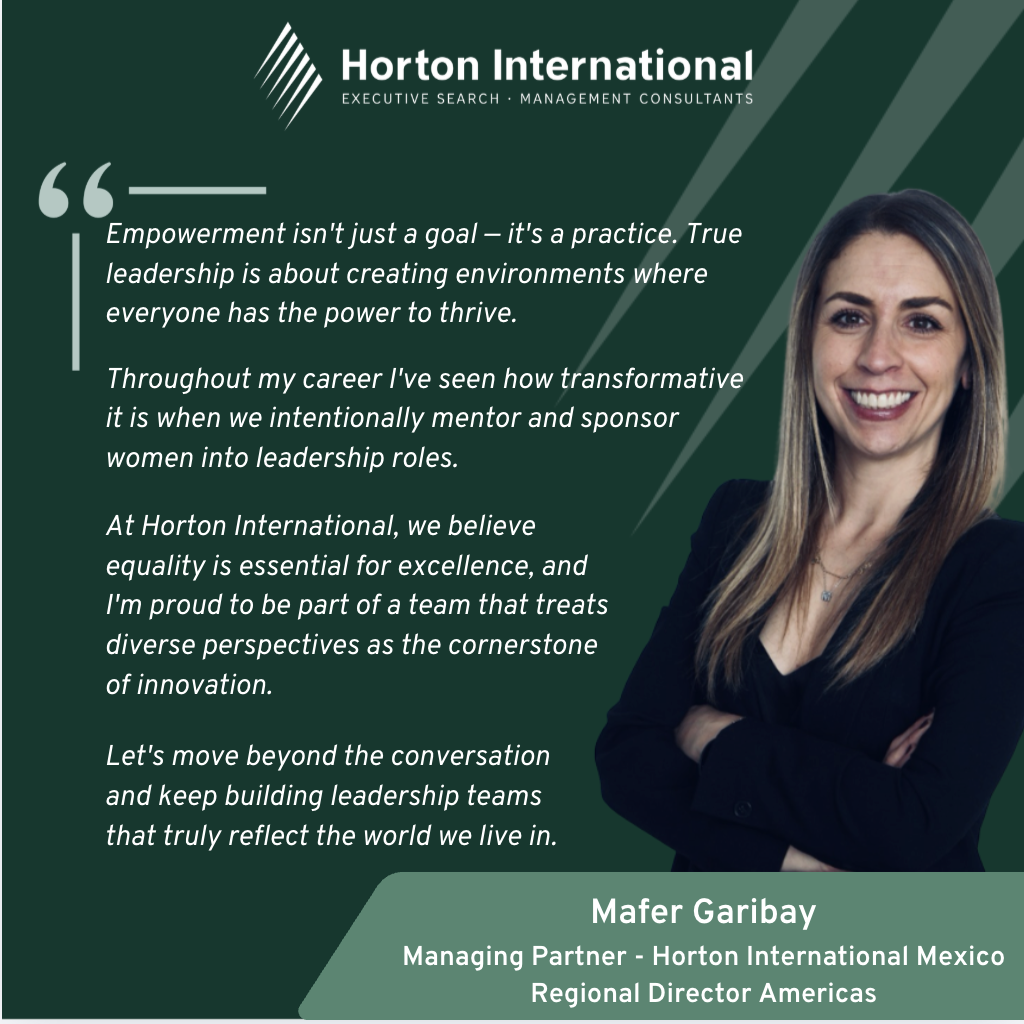
Throughout my career I’ve seen how transformative it is when we intentionally mentor and sponsor women into leadership roles. At Horton International, we believe equality is essential for excellence, and I’m proud to be part of a team that treats diverse perspectives as the cornerstone of innovation.
Mafer Garibay, Managing Partner, Horton International Mexico & Regional Director, Americas
Three Hiring Practices That Perpetuate the Gap – And How to Fix Them
Hiring practices often unintentionally reinforce gender imbalances. Here’s how; and what to do instead:
-
Job Descriptions That Deter Women
Problem: Language that appeals more to men (“challenging” “competitive” etc) discourages women from applying.
Solution: Use gender-neutral language and focus on skills and outcomes.
-
Homogenous Interview Panels
Problem: Panels lacking diversity perpetuate bias, leading to homogenous hiring decisions.
Solution: Ensure diverse interview panels with a range of perspectives.
-
Promotion Criteria That Favour Men
Problem: Traits traditionally associated with men (eg assertiveness) are often prioritised over collaborative leadership styles.
Solution: Standardise evaluation criteria to focus on measurable contributions and potential.
Best practices for inclusive hiring:
- Blind recruitment to remove unconscious bias from initial screening.
- Structured interviews with standardised questions to evaluate candidates fairly.
The Global Perspective: Where Does Your Region Stand?
The Global Gender Gap Index 2025 reveals that while progress has been made, full gender parity remains elusive. Globally, women hold just 35.4% of management positions and regional disparities are stark. Northern Europe leads, with Iceland, Finland, and Norway closing over 80% of their gender gaps. But the Middle East and North Africa lag behind, with women holding only 10.5% of political leadership roles.
Globally, economic participation remains the most significant gap, with women underrepresented in high-paying industries like technology and finance.
Key takeaway for executives:
Benchmark your organisation’s progress against global standards. If your region lags, invest in gender gap senior leadership development and advocate for policies like equal parental leave and flexible working arrangements.
ERGs and Inclusive Cultures: Are They Working?
Women led Employee Resource Groups (ERGs) play a vital role in supporting women’s advancement, but their effectiveness depends on intentional design.[5] Many organisations have broadened ERGs to include all employees, which can dilute their impact.
How to maximise ERGs:
- Focus on sponsorship and advocacy to address specific barriers faced by women.
- Provide resources and visibility for women-led initiatives.
- Measure outcomes to assess the impact of ERGs on women’s career progression.
Taking ERGs seriously through inclusive culture:
- Promote transparency in career pathways and promotion criteria.
- Encourage allyship among male colleagues.
- Address micro-aggressions and bias through training and accountability. 13% of women planning to leave their jobs say micro-aggressions affect their mental health enough to cause them to seek change.[6]
Your Three-Step Framework for Change
For executives ready to act, here’s where to start:
Audit Your Female Executive Pipeline – use data to identify where women are stagnating – especially at the first promotion to manager.
Invest in Sponsorship – pair high-potential women with senior leaders who will advocate for their advancement.
Hold Leaders Accountable – tie diversity metrics to performance reviews and compensation.
The cost of inaction isn’t just moral; it’s financial – and the time to fix the pipeline is now.
Diversity is often celebrated in words, but rarely designed into leadership in practice. Our real mandate is to shape the architecture of leadership — building executive teams that are diverse, complementary, and built to perform.
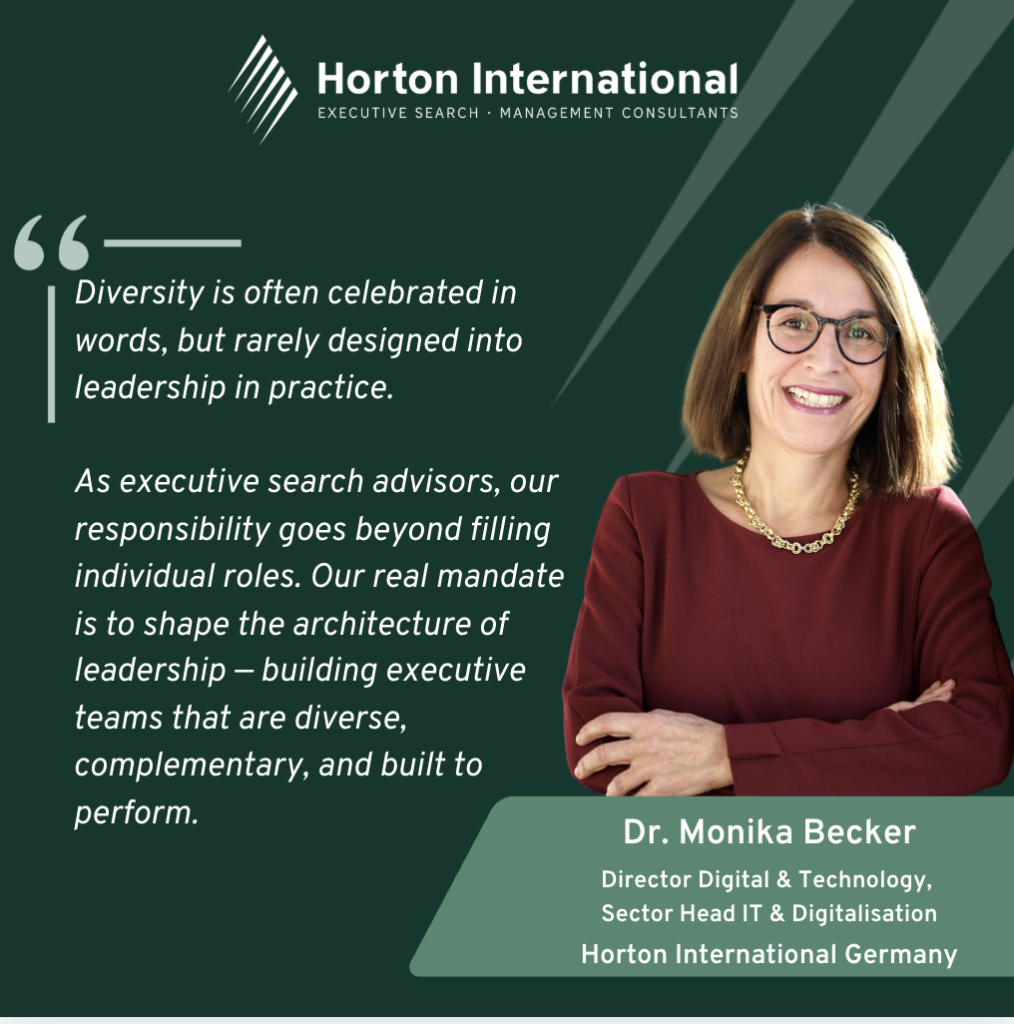
Diversity is often celebrated in words, but rarely designed into leadership in practice. Our real mandate is to shape the architecture of leadership, building executive teams that are diverse, complementary, and built to perform.
Conclusion: The Future of Leadership Is Diverse
Gender parity in leadership is not just a moral imperative – it’s a business necessity. Diverse leadership teams drive better decision-making, innovation, and financial performance. Organisations must move beyond rhetoric and take concrete steps to address the structural barriers holding women back.
The leadership pipeline problem is solvable, but it requires commitment, accountability, and a willingness to challenge the status quo. By investing in women’s careers today, organisations can build a future where leadership reflects the diversity of the global workforce – and where every woman has the opportunity to reach her full potential.
Sources
[1] https://www.weforum.org/publications/global-gender-gap-report-2025/
[2] https://www.mckinsey.com/capabilities/people-and-organizational-performance/our-insights/women-in-the-workplace
[3] https://www.mckinsey.com/capabilities/people-and-organizational-performance/our-insights/women-in-the-workplace
[4] https://www.mckinsey.com/capabilities/people-and-organizational-performance/our-insights/women-in-the-workplace
[5] https://www.mckinsey.com/capabilities/people-and-organizational-performance/our-insights/women-in-the-workplace
[6] https://www.deloitte.com/us/en/insights/topics/talent/work-life-balance-for-women.html#gender-equality