

Every boardroom discussion today revolves around AI, cybersecurity and digital transformation – yet the executives with the deepest expertise in these areas are conspicuously absent.
This is not just an oversight but a strategic risk. As transformation programmes falter and investor scrutiny intensifies, the question is not whether CIOs belong in the boardroom but how quickly they can get there.
The absence of CIO on board of directors is a potential threat, especially as organisations grapple with the pace of technological change. For technology leaders in the boardroom, the opportunities have never been clearer.
The Four Barriers Holding CIOs Back
The underrepresentation of CIOs on corporate boards is not accidental. Four persistent barriers have limited their access.
- Role Perception – CIOs are still widely seen as technology implementers rather than strategic business partners. Boards assume candidates with finance, operations or general management backgrounds will deliver broader governance experience.
- Financial and Governance Expertise – Many CIOs lack direct profit and loss responsibility or exposure to capital allocation, risk management and shareholder relations. Even if they’re driving digital transformation, this credibility gap can undermine them.
- Communication Style – Over-reliance on technical language or analyst reports can suggest a lack of independent business judgement. CIOs must learn to reframe their communication so it sits with board level expectations.
- Board Composition – Boards have traditionally favoured CEOs, CFOs and COOs for their direct link to shareholder value. Even though cybersecurity, AI and digital transformation are now topping the agenda, boards can have a blind spot, resulting in significant CIO underrepresentation.
Why Boards Can’t Afford to Wait
The urgency for CIOs to secure board positions is powerful. 70% of transformation programmes are failing,[1] investor pressure is mounting and AI risk is now a staple on every board agenda. According to PwC’s 2025 Board Effectiveness Survey, 40% of CIOs now rate their boards’ effectiveness as poor, a record high[2] . This frustration stems from a critical gap. Boards lack the expertise to oversee AI, cybersecurity and digital transformation, even as these issues dominate agendas.
“Good CIOs transform IT from inside, but great CIOs use design thinking and inclusivity to transform IT by changing what happens outside…” ~Vipin Gupta, Chief Innovation and Digital Officer, Toyota Financial Services[3]
Organisations can no longer afford to exclude the executives who understand these challenges most deeply. Boards are increasingly recognising that technology is not just an operational function but a core driver of business strategy. 52% of surveyed CIOs say that their work will be strategic rather than technical for the next three to five years.[4] Without CIOs in the room, boards risk making decisions based on incomplete or outdated information.
However, boards do not need another technical advisor. They need a director who can do the following.
Translate risk into resilience – Frame cybersecurity and AI challenges in terms of business continuity, reputation and shareholder value.
Drive growth through innovation – Demonstrate how technology investments directly contribute to revenue, efficiency and competitive advantage.
Bridge the governance gap – Provide oversight on digital ethics, regulatory compliance and emerging risks, areas where most boards currently lack depth.
Challenge assumptions – Ask the hard questions that others might overlook, from data privacy to AI bias and beyond.
From IT Operator to Board Ready Director: A Six Step Playbook
To transition from the server room to the boardroom, CIOs must adopt a deliberate strategy.
Step 1: Rebrand as a Business Leader
Rewrite your professional narrative. A board CV should lead with your ability to drive business outcomes, not just deliver IT projects. Highlight cross-functional leadership, such as cost optimisation, revenue growth or risk mitigation.
Step 2: Speak the Language of the Board
Replace jargon with business impact. Instead of discussing zero trust architecture, talk about reducing operational downtime by 30% or protecting 500 million dollars in annual revenue from cyber threats.
Step 3: Gain Financial Fluency
Enrol in governance or financial certification programmes, for example INSEAD’s International Directors Programme. Understand how boards evaluate profit and loss, capital allocation and shareholder returns.
Step 4: Build a Public Profile
70% of board seats are filled through networks.[5] Publish insights on LinkedIn, speak at industry conferences and engage with executive search firms. Visibility is a prerequisite.
Step 5: Expand Your Scope
Volunteer for cross-functional roles, such as leading a digital transformation task force or overseeing procurement. Boards seek executives with enterprise wide perspective, not siloed expertise.
Step 6: Master the Governance Mindset
On a board, your role shifts from problem solving to strategic oversight. Practice asking incisive questions, for example, ‘how does this AI initiative align with our long term risk appetite?’ rather than providing answers.
“IT cannot just be the organization that ‘manages a utility’—as it has often been perceived—but it must now run the business of the business.”~Javier Polit, Chief Information and Digital Officer at Costco (2024)[6]
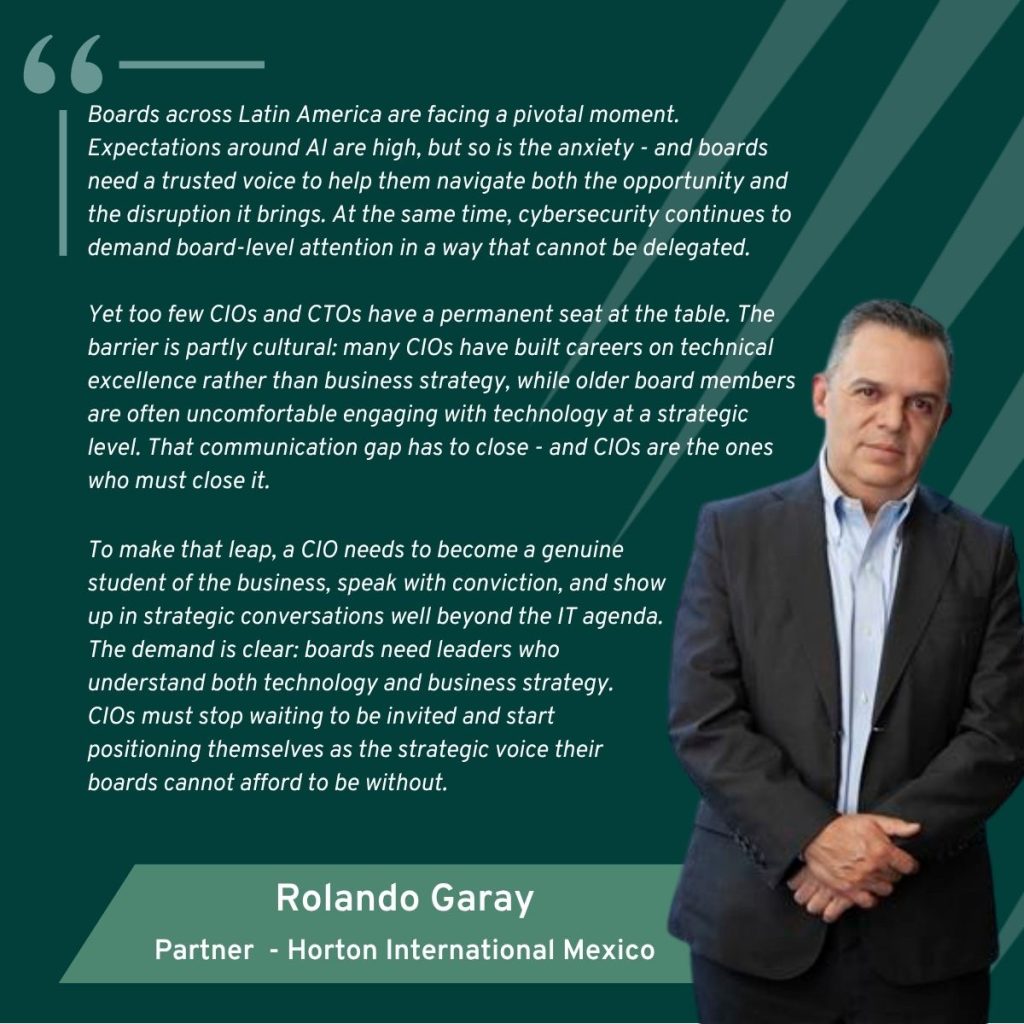
Rolando Garay, Managing Partner, Horton International Mexico, reflects on what this means for boards and technology leaders across Latin America:
Urgency, threats, insight
The case for CIOs on boards of directors is compelling. As digital transformation accelerates and AI reshapes industries, boards need directors who can provide informed oversight and strategic guidance. CIOs who take proactive steps to build their governance skills, expand their networks and reframe their contributions will be best positioned to secure these roles.
For organisations, the message is clear. The most effective boards will be those that include technology leaders who can bridge the gap between innovation and governance. By bringing CIOs into the boardroom, companies can ensure they are equipped to navigate the challenges and opportunities of the digital age.
Conclusion
The path from IT leadership to boardroom influence is not automatic but it is achievable. CIOs who recognise the need to evolve from technical experts to strategic leaders will find themselves in high demand. For boards, the inclusion of technology astute directors is no longer optional. It is a necessity for long term success.
The future of technology expertise on corporate boards is not a question of if but when. The organisations that act first will gain a competitive edge that can’t be overlooked.
Sources
[1] https://www.forbes.com/sites/shaheenajanjuhajivrajeurope/2025/11/12/when-leaders-failwhy-70-of-organisational-transformations-flop/
[2] https://corpgov.law.harvard.edu/page/57/
[3] https://www.hellersearch.com/blog/the-quotable-cio-10th-edition
[4] https://www.cio.com/article/3974090/state-of-the-cio-2025-cios-set-the-ai-agenda.html
[5] https://www.forbes.com/councils/forbestechcouncil/2020/10/15/networking-its-not-what-you-think/
[6] https://digitaldefynd.com/IQ/famous-cio-quotes/