
A CEO arrives at their desk, opens an AI platform, ask a question and within seconds receives what appears to be a definitive answer to a complex strategic problem. It’s efficient. It’s data-driven. And it might be exactly the wrong approach.
This scenario plays out in boardrooms worldwide. As we navigate 2026, a striking paradox has emerged: whilst 40% of organisations highlighting AI in earnings calls see share price increases, those that treat technology as merely another tool to implement – rather than as part of a broader human strategy – may be creating more problems than they solve. The leaders who will truly distinguish themselves aren’t those who’ve simply mastered the latest AI platform or automation tool – they’re those who’ve learned to harness innovation whilst keeping human-centred leadership at the core of every decision.
Technology may drive efficiency, but people drive success and leaders who can balance both will define the next era of business.
The Deceptive Simplicity of Digital Solutions
Generative AI offers seductive promises: instant answers, streamlined processes, data-driven certainty. Yet this deceptive simplicity can trap leaders into applying yesterday’s logic to tomorrow’s challenges, losing the nuance that characterises genuinely complex problems.
Without conscious effort, even ethical technology deployment can diminish diversity of thought and tolerance for constructive dissent; the very things that fuel innovation. The objective shouldn’t be technology deployment itself; but building organisations where AI and people strategy work in concert.
Five Pillars of Human-Centric Technology Leadership
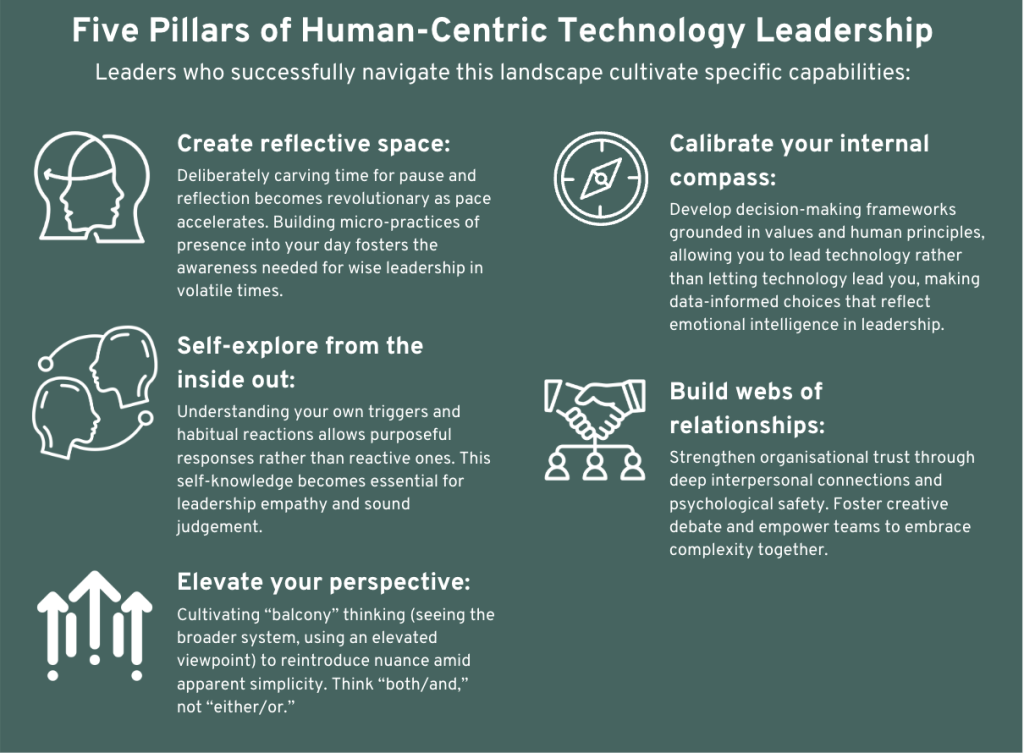
Leaders who successfully navigate this landscape cultivate specific capabilities:
- Create reflective space: Deliberately carving time for pause and reflection becomes revolutionary as pace accelerates. Building micro-practices of presence into your day fosters the awareness needed for wise leadership in volatile times.[1]
- Self-explore from the inside out: Understanding your own triggers and habitual reactions allows purposeful responses rather than reactive ones. This self-knowledge becomes essential for leadership empathy and sound judgement.
- Elevate your perspective: Cultivating “balcony” thinking (seeing the broader system, using an elevated viewpoint) to reintroduce nuance amid apparent simplicity. Think “both/and,” not “either/or.”
- Calibrate your internal compass: Develop decision-making frameworks grounded in values and human principles, allowing you to lead technology rather than letting technology lead you, making data-informed choices that reflect emotional intelligence in leadership.
- Build webs of relationships: Strengthen organisational trust through deep interpersonal connections and psychological safety. Foster creative debate and empower teams to embrace complexity together.
KEY TAKEAWAY: The goal isn’t choosing between people and technology – it’s developing the leadership capacity to integrate both, in ways that recognise human complexity whilst leveraging technological capability.
Translating Values Into Action: Japan’s Journey
How do these principles translate into practice? Japan’s approach to AI leadership offers instructive lessons. Through initiatives like METI’s GENIAC project, the nation demonstrates strong governmental commitment to harnessing AI for economic growth and societal advancement, all whilst grappling with deeply embedded cultural norms.
The challenge is real: Japan ranks third globally in R&D spending yet 47th in entrepreneurial intentions. This disparity reflects a broader cultural aversion to failure and risk; qualities that have historically ensured high standards but can slow disruptive innovation. The central vision comes together in “Society 5.0” – a place where technological innovation harmoniously advances alongside societal values.[2]
What initially appears as a barrier – meticulous attention to precision, stringent ethical standards – becomes a competitive advantage in fields where trust and transparency are paramount. Japan’s commitment to AI systems prioritising fairness and accountability aligns with emerging global governance standards, positioning the nation as a world leader in responsible digital transformation and humanity.
NEC Corporation embodies this integration philosophy. Their AI solutions for manufacturing enhance quality inspection processes whilst preserving the expertise of skilled workers. Rather than replacing human judgement, the technology captures and transmits the knowledge of experienced inspectors to future generations. As their Managing Director explains, “AI will become an indispensable presence as a storyteller, passing down these disappearing specialised skills”.
This demonstrates purpose-driven culture in action – technology augmenting rather than supplanting human excellence. Media coverage has also proved pivotal, helping society distinguish between “failure” and “controlled risk management”. This creates a more supportive environment for experimentation – essential for building genuine employee engagement with AI initiatives.
KEY TAKEAWAY: Japan’s experience shows that perceived cultural constraints – risk aversion, perfectionism, consensus-building – can be transformed into strategic advantages when paired with deliberate frameworks that recognise both innovation and human values.
The Strategic Investment Balance
AI investment isn’t merely about budget allocation; it’s about signalling where value truly resides. Whilst leaders highlighting AI initiatives in earnings calls are 40% more likely to see share price increases, the actual outcome depends entirely on trust and transparency around how technology serves strategic objectives.[3]
Organisations that cultivate high employee engagement through purposeful technology integration report significantly lower turnover.[4] Successful organisations train teams to wield technology as a co-pilot, not a replacement. In an era where employees possess unprecedented mobility, valuing your team becomes the cornerstone of sustained success.
The Recruiter’s Crucial Role
Identifying leaders capable of this delicate balance; those with both technological fluency and profound emotional intelligence in leadership, requires sophisticated assessment. Forward-thinking recruitment at the executive level now prioritises candidates who demonstrate the capacity to host complexity, build trust across diverse stakeholder groups, and articulate clear values frameworks for technology governance in future.
The most impactful leaders aren’t those who view people and technology as competing investments, but rather those who architect environments where both flourish synergistically.
Conclusion: Next Steps
Differentiation won’t come from digital capability alone. It will come from leaders who cultivate space for reflection amid acceleration, who build trust through authentic relationships, and who make technology serve human flourishing.
What can leaders do now?
- Audit their organisation’s investment ratio: for every pound spent on technology, are they investing proportionally in the people who will implement it?
- Examine their decision-making processes: are they data-driven or data-informed?
- Create dedicated time for dialogue about the human implications of technological change, and engage all teams in conversations about how AI can augment their expertise, rather than imposing it as a ‘solution’.
Thriving organisations will be led by individuals who understand that employee engagement, ethical implementation, and strategic innovation aren’t separate objectives – they’re interdependent elements of a coherent vision.
Technology may change how we work, but humanity defines why we work and what success truly means. The leaders who grasp this balance will define the next era of business – not through technological prowess alone, but through the wisdom to keep human dignity, purpose, and connection at the heart of every digital transformation.
Sources
[1] https://www.forbes.com/councils/forbescoachescouncil/2025/04/02/power-of-the-pause/
[2] https://www.weforum.org/stories/2024/12/japan-ai-leadership-risk-ethics/
[3] https://www.forbes.com/councils/forbesbusinesscouncil/2023/12/12/human-centric-leadership-in-the-age-of-ai-balancing-technology-and-people/
[4] https://www.forbes.com/councils/forbesbusinesscouncil/2023/12/12/human-centric-leadership-in-the-age-of-ai-balancing-technology-and-people/