
Across industries, digitalisation is no longer something that simply supports the business, it has become a core business strategy. But if digitalisation has become a strategic discipline, why do so many organisations continue to recruit digitalisation leaders based primarily on their technical expertise rather than their ability to drive business transformation?
Research from both McKinsey (1. McKinsey Transformation 2022) and Boston Consulting Group (2. BCG Platinion 2026) suggests that up to 70% of digital transformation initiatives fail to deliver their intended outcomes. Across this research, a recurring theme is that successful transformation depends on much more than technology and systems. It also requires the right people, organisational adoption and mindset.
Finding the Right Leader for Digital Transformation
In a recent executive search assignment, we were asked to identify a new digitalisation leader for an organisation preparing for a major digital and business transformation initiative.
At the outset, the discussion centred on technologies, platforms and systems. However, as we worked closely with the client to understand the real business challenges, it became clear that the organisation was actually looking for something very different.
The Digital Mindset
Together with our client, we explored a fundamental question: if technology is not the most important factor, what is? We concluded that the real differentiator is the ability to translate technology into business value. Instead of focusing solely on candidates’ technical toolkits, we began assessing what we refer to as their digital mindset. Four dimensions became central to our search:
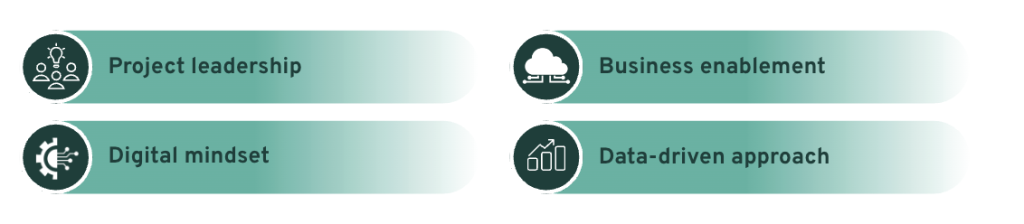
Project Leadership
Admittedly, project management often brings to mind Gantt charts, budgets and delivery plans. But in a modern transformation, project management is not about following a set plan, but about leading in uncertainty. Today’s digitalisation leaders need to manage iterative projects, adapt quickly when circumstances change, learn from failure and navigate the complex intersection between technology, business and people.
Business Enablement
At first glance, business enablement may sound like the traditional view of IT supporting the business. Our experience aligns more closely with contemporary leadership thinking from organisations such as MIT (3. MIT CISR 2017), where digitalisation and business strategy are inseparable. Technology is no longer a support function. It is one of the primary ways organisations create competitive advantage. The right leader is therefore able to translate cloud architecture, digital platforms and technology investments into tangible business outcomes and new revenue opportunities.
The Digital Mindset
“Digital mindset” has become something of a buzzword. Yet throughout our search we realised that the organisation lacked what might be called mental software. A genuine digital mindset is built on curiosity, psychological safety and continuous learning. It is the ability to help an organisation let go of established habits and embrace new ways of working. The role of the leader is not primarily to be the technical expert, but to become a catalyst for cultural change.
A Data-Driven Approach
Almost every candidate claims to be data-driven. In the age of AI, however, being datadriven means far more than monitoring KPIs.
It requires data fluency: the ability to interpret data, identify patterns and use predictive insights to make better strategic decisions. It also requires the confidence to challenge assumptions, experience and intuition with objective evidence.
Conclusion
When we conduct executive search assignments, we rarely recruit for technology alone. We recruit leaders who have demonstrated the ability to convert technology into measurable business value.
Ultimately, we concluded that the most visionary digital transformation leader was not the person with the deepest knowledge of ERP platforms or server infrastructure. It was the person capable of bringing together business strategy, data and human behaviour to create lasting organisational transformation.
Sources:
- McKinsey Transformation 2022: https://www.mckinsey.com/capabilities/transformation/our-insights/common-pitfallsin-transformations-a-conversation-with-jon-garcia
- BCG Platinion 2026: https://www.bcgplatinion.com/insights/why-70-oftransformations-miss-the-mark-and-how-to-fix-them
- (MIT CISR, Peter Weill and Stephanie L. Woerner 2017): https://cisr.mit.edu/publication/2017_0901_DigitalPathways_WeillWoerner