
Workplace culture is a critical business imperative, and the gap between how leaders perceive it and how employees experience it day to day has rarely been wider. Recent DEI U-turns have only sharpened that disconnect, exposing how quickly stated values can diverge from lived experience on the ground.
This is often most pronounced for marginalised groups, including LGBTQ+ employees, who continue to navigate environments that don’t always reflect the values their organisations claim to uphold.
This underscores a fundamental truth: inclusive culture cannot be delegated to HR or treated as a compliance exercise. It must be championed from the very top.
Why CEO Leadership Drives Cultural Transformation
Recognition alone isn’t enough. When culture, strategy, and operations align under strong CEO leadership, organisations see tangible results. Organisations with above-average diversity in their management teams generate 38% more revenue from innovative products and services than less diverse peers, according to Boston Consulting Group research.
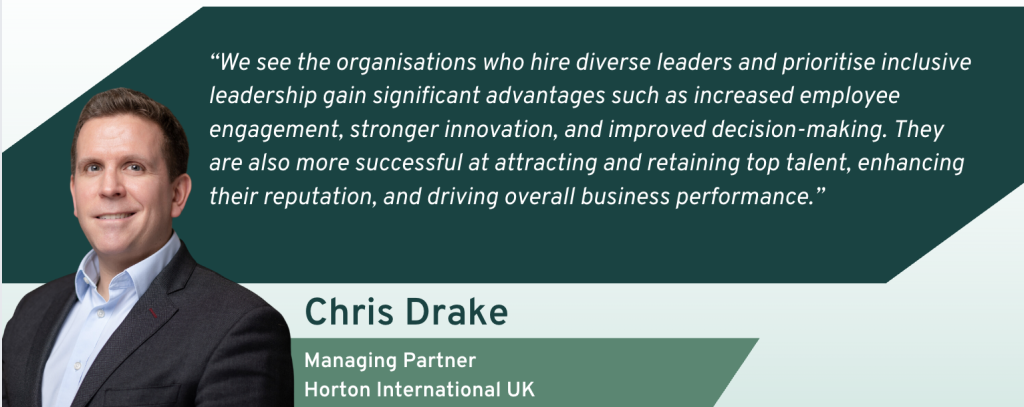
Chris Drake – Managing Partner, Horton International UK
The role of the CEO in driving inclusive culture extends far beyond symbolic gestures or policy announcements. It requires a fundamental shift in how leaders approach their responsibilities, moving from traditional command-and-control models to inclusive leadership styles that foster belonging and psychological safety.
Key CEO Actions for Cultural Alignment:
- Conduct regular culture audits to identify gaps between current state and strategic objectives – find out if your team think something needs to change
- Ensure leadership compensation and performance metrics have inclusion indicators as standard
- Personally participate in employee resource groups and listening sessions
- Make organisation culture a standing agenda item in board meetings and executive reviews.
The Business Case for Inclusive Leadership
Beyond moral imperatives, inclusive leadership is linked to measurable business outcomes. Psychological safety, the foundation of an inclusive culture, has been shown to improve how early organisations detect and address misconduct, since employees are more willing to raise concerns before they escalate into formal complaints or legal exposure.
Academic research by Scott Page, a University of Michigan professor of complex systems and economics, shows that teams with cognitively diverse perspectives can outperform more homogeneous groups on complex problem-solving tasks, even when individual members have less expertise than their counterparts. The same logic extends beyond demographic diversity: cognitive and neurodiverse perspectives are increasingly recognised as valuable for building organisational resilience, particularly in volatile or uncertain conditions.
Measurable benefits include:
- Reduced employee turnover and associated recruitment costs
- Enhanced brand reputation and employer value proposition
- Improved risk management through early issue identification.
Importantly, more than one in five Gen Z adults identify as LGBTQ+, and they are significantly more likely to leave employers that lack genuine inclusion efforts — almost half worry that discrimination will affect their career progression, compared to just 30% of Gen X. This generational shift reflects a broader pattern: nearly half of UK-based LGBTQI+ workers report having faced discrimination at work at some point in their career, and around one in three have quit a job due to feeling uncomfortable being themselves at work.
These realities underscore the need for inclusive leadership not just as a moral commitment, but as a critical talent and retention strategy for future-focused organisations.
Defining Inclusive Leadership in Practice
Inclusive leadership centres on creating environments where every employee feels valued, respected, and empowered to contribute authentically. This leadership style encompasses several critical behaviours that CEOs must model consistently.
Core Inclusive Leadership Traits:
Empathy and Active Listening: CEOs must demonstrate genuine curiosity about their people’s experiences and actively seek to understand what motivates them, rather than making assumptions based on backgrounds or appearances.
Vulnerability and Learning Orientation: Effective inclusive leaders acknowledge their own learning journey, openly admitting when they make mistakes and demonstrating how to recover constructively from cultural missteps.
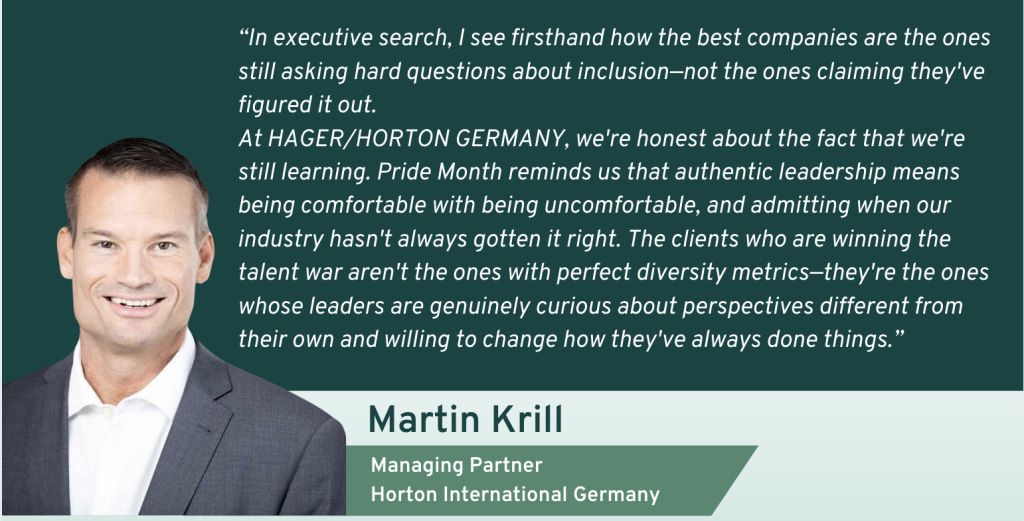
Martin Krill, Managing Partner Horton International Germany
Consistent Behaviour: Inclusive leadership requires consistent demonstration of values across all interactions, not just during formal diversity and inclusion initiatives.
Curiosity Over Assumptions: Rather than relying on preconceived notions, inclusive leaders actively seek to understand different perspectives and challenge their own biases.
Creating Psychological Safety from the Top
Psychological safety – the belief that one can speak up without risk of punishment or humiliation – forms the foundation of truly inclusive cultures. When CEOs model vulnerability and respond constructively to feedback, they create permission for others to do the same.
The challenge lies in moving beyond surface-level inclusivity to a culture where differences genuinely shape decisions, not just appearances.
CEO Strategies for Building Psychological Safety:
- Share personal stories of failure and learning to normalise vulnerability
- Respond to challenging feedback with curiosity rather than defensiveness
- Publicly acknowledge and address cultural blind spots
- Create multiple channels for anonymous and direct feedback.
Fostering Inclusive Speak-Up Cultures
Recent research shows more than half of employees who don’t report workplace misconduct stay silent because they believe nothing will change, while over a third cite fear of retaliation.
An inclusive speak-up culture encompasses three essential elements: Speak Up, Listen Up, and Follow Up. CEOs must model each component personally whilst ensuring systems and processes support organisation-wide implementation.
Essential Elements of CEO-Led Speak-Up Cultures:
- Model curiosity by actively seeking input from all organisational levels
- Demonstrate inclusive communication by acknowledging diverse perspectives
- Create multiple, accessible reporting channels to accommodate different comfort levels
- Close feedback loops by transparently sharing outcomes and actions taken.
Building Trust Among Senior Leadership Teams
Trust at the senior leadership level cascades throughout organisations, creating ripple effects that either enhance or undermine inclusive culture efforts. When CEOs demonstrate trust in their direct reports and model inclusive behaviours in executive team interactions, they set the tone for organisational norms.
CEO Actions for Building Senior Leadership Trust:
- Regularly examine and address power dynamics within the executive team
- Ensure diverse representation in succession planning and leadership development
- Create safe spaces for senior leaders to practice inclusive behaviours
- Establish accountability measures for inclusive leadership behaviours.
Practical Implementation Strategies
Successful inclusive culture transformation requires systematic approach rather than ad-hoc initiatives. CEOs must focus on a limited but critical number of behaviours that will drive the most significant cultural shifts whilst maintaining consistent effort over time.
Implementation Framework:
- Identify three to five critical behaviours that align culture with strategic objectives
- Demonstrate these behaviours personally and consistently
- Recognise and reward others who model these behaviours
- Measure progress through both quantitative metrics and qualitative feedback.
Measuring Success and Sustaining Change
Culture change efforts often fail because leaders declare victory too soon. Recent research found that 72% of culture initiatives led to no measurable improvement, often because employees experienced them as superficial – by contrast, when senior leaders changed their own behaviour and ways of working, even without a formal programme, trust scores rose by 26%. Sustainable change requires long-term commitment and continuous measurement, not one-off initiatives or perks.
Key Metrics for CEO Monitoring:
- Employee engagement scores across demographic groups
- Internal promotion rates by background and identity
- Speak-up reporting trends and resolution rates
- Exit interview feedback themes and patterns.
Moving Forward: From Compliance to Care
The most successful inclusive cultures emerge when CEOs shift from compliance-driven approaches to genuine care for their people’s experiences. This requires humility, open-mindedness, and willingness to act on feedback even when – especially when – it’s uncomfortable.
When employees feel their voices truly matter, they don’t just speak up; they stay. Their contribution helps the organisation thrive. This transformation begins with CEOs who lead from the front, demonstrating that inclusive leadership isn’t just good business – it’s the only sustainable path forward in our interconnected world.
The journey towards inclusive culture requires courage, consistency, and commitment from the very top. CEOs who embrace this challenge will find themselves leading not just more inclusive organisations, but more innovative, resilient, and successful ones.
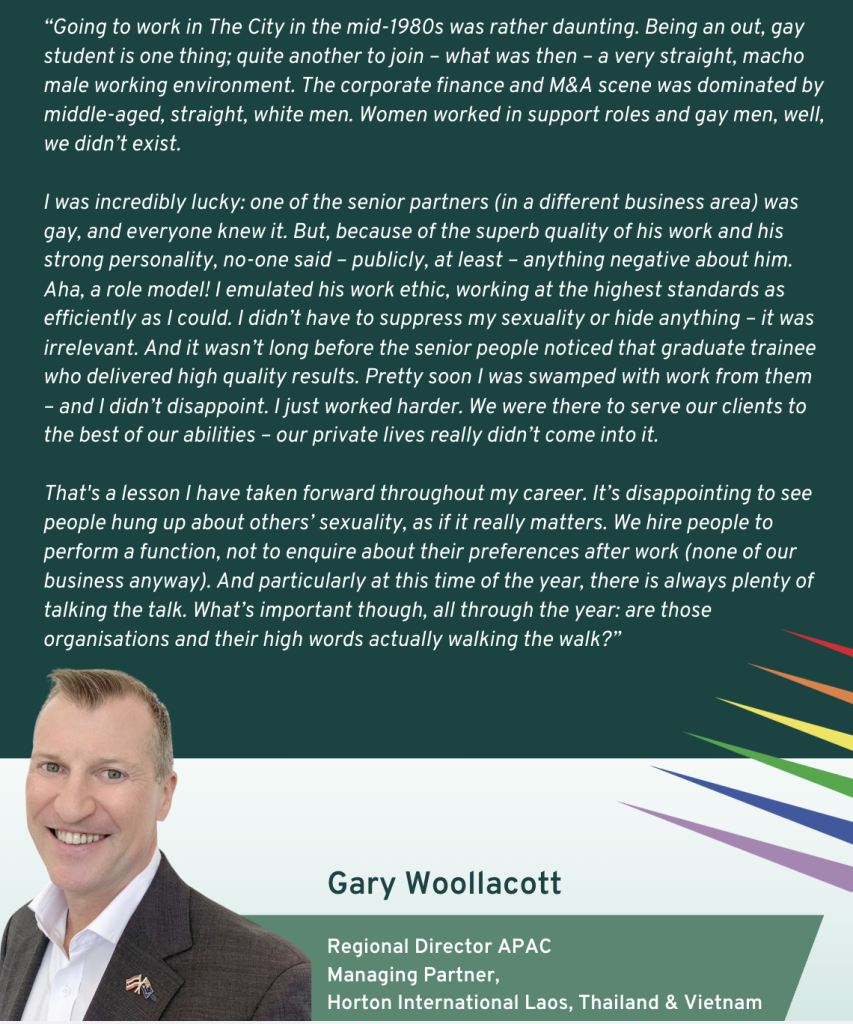
Gary Woollacott, Regional Director APAC – Managing Partner, Horton International Laos, Thailand & Vietnam
Sources:
https://news.gallup.com/poll/702206/lgbtq-identification-holds.aspx
https://sites.lsa.umich.edu/scottepage/home/the-difference/
https://hbr.org/2025/08/to-change-company-culture-focus-on-systems-not-communication
https://www.octanner.com/articles/5-culture-trends-2026