
Guest Author
In this guest article, Kay Sexton draws on more than two decades of experience as a charity Chief Executive and think tank administrator, where her work in social and ethical accountability fuelled her interest in diversity, disability and equity. Now working as a sighted guide and a freelance writer, and bringing her own lived experience as a brain injury survivor, Kay shares her perspective on the barriers, progress and opportunities for blind and visually impaired people in the workplace.
Being blind shouldn’t be a barrier to employment, but it is. Economies that miss out on more than £2 billion of gain are limiting their prosperity, and the people who suffer most when an economy doesn’t thrive tend to be disabled. For C-suite executives, understanding the barriers, opportunities and business case for disability inclusion, particularly for those with visual impairments, is not just a moral imperative but a strategic asset.
The Current Landscape: Barriers and Disparities
The employment gap for visually impaired individuals is stark. In the UK, only 27% of registered blind or partially sighted people are in employment, compared to 76% of the general population.[1] This disparity translates to an estimated £2.43 billion indirect cost to the UK economy annually.[2] Similarly, in the US, the labour force participation rate for people with visual impairments stands at just 40%, significantly lower than the 74% for those without disabilities.[3]
These statistics underscore a systemic issue: employers are missing out on a vast pool of talent. A 2023 report by the All Party Parliamentary Group (APPG) on Eye Health and Visual Impairment revealed that 75% of UK employers would want to employ a blind or partially sighted person but do not know how to do so.[4] Worse still, 25% of employers are unwilling to make workplace adaptations, and 48% lack accessible recruitment processes.[5]
The Business Case for Disability Inclusion
The case for employing visually impaired professionals is compelling. Organisations that embrace disability inclusion and inclusive leadership gain access to a talent pool that is often overlooked but rich in adaptability, creativity and problem-solving skills. Blind and visually impaired professionals, such as Neil Heslop (CEO of Charities Aid Foundation), Amar Latif (founder of Traveleyes) and David Clarke (CEO of Paralympics GB), have demonstrated that leadership is not defined by sight but by vision; metaphorically speaking.
Key Benefits:
- Enhanced Problem-Solving: Visually impaired individuals often develop heightened adaptability and innovative approaches to challenges, which can drive organisational resilience.
- Diverse Perspectives: Inclusive teams bring a broader range of experiences, leading to more creative and effective decision-making.
- Improved Employee Retention: Companies that prioritise inclusive workplaces report higher job satisfaction and retention rates among all employees, not just those with disabilities.
- Legal Compliance and Reputation: Adhering to legislation such as the UK Equality Act 2010 and the US Americans with Disabilities Act (ADA) not only avoids penalties but also enhances an organisation’s reputation as a socially responsible employer.
Universal Jargon Buster
BVI – (USA) blind or visually impaired
VIP – (UK) visually impaired person
AT – assistive technology
AtW (UK) – Access to Work, the government programme to support disabled people in the workplace
Registered blind (UK) – a government declaration. It doesn’t mean the person cannot see anything at all, but it means their visual impairment is substantial enough to prevent them driving and automatically entitles them to certain benefits and levels of support.
WCAG – Web Content Accessibility Guidelines (and SCULPT – a UK-based system to make WCAG easier for organisations).
Assistive Technology: A Game-Changer
Assistive technology is transforming the workplace for visually impaired professionals. Tools such as:
- Screen readers (JAWS, NVDA) that convert digital text into synthesised speech or Braille.
- Screen magnification software for individuals with low vision.
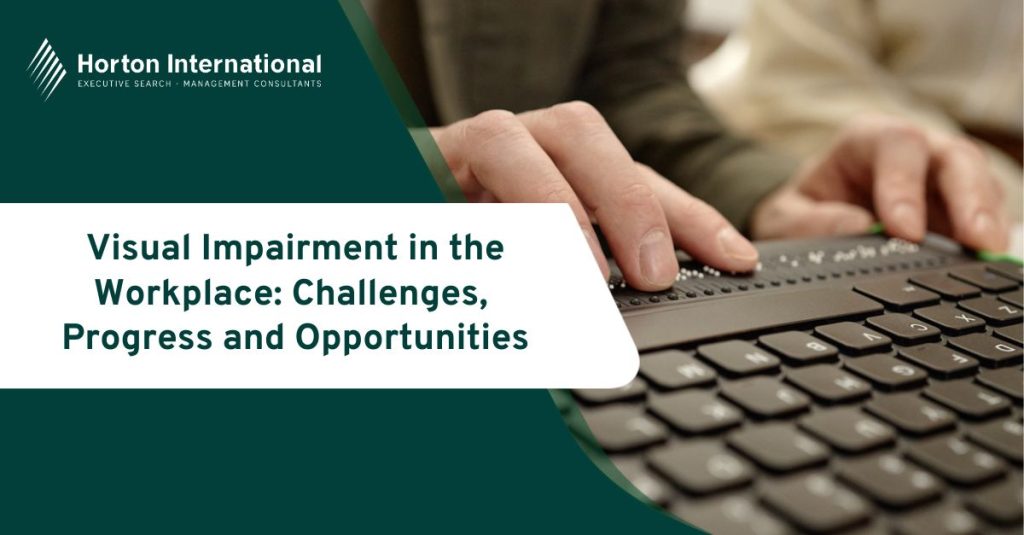
- Refreshable Braille displays that provide real-time access to digital content.
- Voice recognition software (Dragon, NaturallySpeaking) for hands-free computer control.
These technologies enable visually impaired employees to perform roles ranging from administrative tasks to executive leadership.
Physical and Digital Accessibility
Creating an accessible workplace goes beyond technology. Physical accommodations such as clear pathways, tactile markings, adjustable lighting and ergonomic workstations are essential. Digital accessibility is equally critical: websites, software and documents must adhere to the Web Content Accessibility Guidelines (WCAG) to ensure usability for all.
Flexible work arrangements, such as remote work and adjustable schedules, further support visually impaired employees by allowing them to work in environments tailored to their needs.
The Role of Inclusive Leadership and Recruitment
Inclusive leadership is the cornerstone of a workplace where visually impaired professionals can thrive. Leaders must move beyond compliance and actively foster a culture of empathy, understanding and collaboration. Accessible recruitment practices are a critical first step. This includes:
- Ensuring job descriptions and application processes are accessible.
- Providing interview materials in advance and in accessible formats.
- Training recruiters and hiring managers on disability awareness and the capabilities of assistive technologies.
Organisations should also establish internal disability groups and forums to amplify the voices of visually impaired employees and to allow such forums to serve as critical friends to leadership. Disability awareness training can help leaders identify and address their own “blind spots” in empathy and emotional intelligence.[6]
Actions for Organisations: A Roadmap to Inclusion
To create inclusive workplaces where visually impaired professionals can excel, organisations should take the following actions:
-
Develop a Comprehensive DEI Strategy
- Integrate disability inclusion into your broader DEI strategy, ensuring it is treated with the same importance as other diversity initiatives.
- Set measurable goals for the recruitment, retention and promotion of visually impaired employees.
-
Invest in Accessibility
- Conduct accessibility audits of physical workspaces, digital platforms and recruitment processes.
- Implement workplace accommodations such as assistive technologies, adjustable lighting and ergonomic furniture as standard practice and ensure all digital content adheres to WCAG standards.
-
Foster Inclusive Leadership
- Provide inclusive leadership training for executives and managers, focusing on empathy, active listening and emotional intelligence.
- Encourage leaders to engage directly with visually impaired employees to understand their needs and perspectives, but be aware of ‘disability fatigue’ – the constant demand to be a spokesperson for (and expert in) your own disability can create more stress and extra work for disabled people than for their colleagues.
-
Promote Accessible Recruitment – reduce your ‘blind spots’
- Partner with organisations such as the RNIB (Royal National Institute of Blind People), Thomas Pocklington Trust or Blind in Business to access talent pools of visually impaired professionals.
- Ensure recruitment processes are accessible, from job postings to interviews.
-
Build a Culture of Empathy and Understanding
- Roll out disability awareness training for all employees, from the C-suite to entry-level staff; consider making it mandatory for people to complete diversity training before they can post employment vacancies.
- Create mentorship and sponsorship programmes to support the career progression of visually impaired people and disabled people generally.
-
Leverage Government and NGO Support
- Utilise schemes like the UK’s Access to Work and US resources such as the Job Accommodation Network (JAN) to fund and implement accommodations.
- Collaborate with sight loss charities and NGOs to stay informed about best practices and emerging technologies.
Case Studies: Success in Action
UK: Seema Flower and Blind Ambition
Seema Flower, a totally blind entrepreneur and CEO of Blind Ambition, has dedicated her career to improving accessibility and inclusion. Her work with major organisations, including the UK Parliament and Microsoft, demonstrates how inclusive leadership and workplace accessibility can drive meaningful change. Flower’s advocacy has helped connect employers with visually impaired job seekers, proving that talent knows no visual boundaries.[7]
USA: Kamille Richardson – Inclusivity in Action
Blind entrepreneur Kamille Richardson has spoken about the barriers she faced in pursuing a career in the media before later retraining as a massage therapist.[8] However, her entrepreneurial spirit was unwilling to admit defeat. Today, her company iSee Technologies, partners Fortune 500 Companies such as Disney and Kraft Heinz, helping them to become more inclusive. She is also a keynote speaker, sharing facts about disability inclusion such as:
- disability inclusion earns 28% higher profit
- companies championing disability inclusion tend to have average revenue 1.6 times higher than their competitors
- 28.7% of Americans live with disability, that’s around $18 trillion spending power, which could be leveraged to create loyal customers and hire top talent.[9]
https://www.dw.com/en/visual-impairments-at-work/video-55788022
The Path Forward: Opportunities for Growth
- Visual impairment in the workplace is a pressing issue, with employment rates for visually impaired individuals lagging far behind the general population in both the UK and US.
- Workplace accessibility and assistive technology are critical enablers for visually impaired professionals.
- Inclusive leadership and accessible recruitment practices are essential to attracting and retaining visually impaired talent.
- Disability inclusion is not just a moral imperative but a strategic advantage that drives innovation and business success.
- Organisations must take proactive steps, from developing a proactive DEI strategy to leveraging government support, to create inclusive workplaces where visually impaired professionals can thrive.
Sources
[1] https://journals.sagepub.com/doi/10.1177/02646196241305285
[2] https://link.springer.com/article/10.1186/s12913-018-2836-0
[3] https://www.hcamag.com/us/specialization/diversity-inclusion/visually-impaired-employees-still-facing-hiring-wall/455089
[4] https://www.aop.org.uk/ot/news/2024/10/29/step-change-needed-in-attitudes-towards-blind-and-partially-sighted-people-at-work
[5] https://www.aop.org.uk/ot/news/2024/10/29/step-change-needed-in-attitudes-towards-blind-and-partially-sighted-people-at-work
[6] https://journals.sagepub.com/doi/10.1177/02646196241305285
[7] https://www.blindambition.co.uk/about/seema-flower-biography/
[8] https://peopleofcolorintech.com/articles/meet-the-blind-ceo-who-is-helping-companies-become-more-inclusive/
[9] https://peopleofcolorintech.com/articles/meet-the-blind-ceo-who-is-helping-companies-become-more-inclusive/