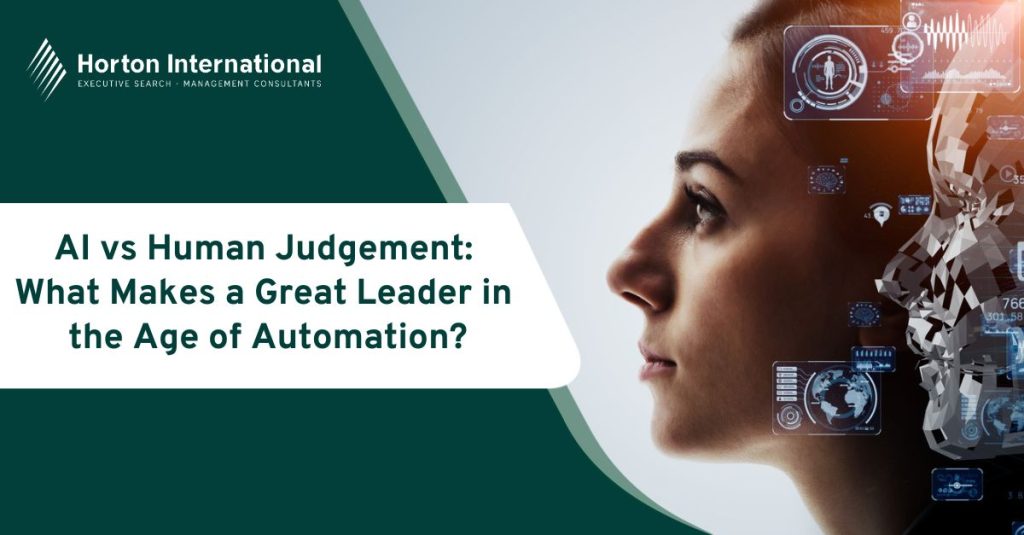

Multiple and partly on-going crises are creating uncertainty in business models and among the workforces. Artificial Intelligence (AI) can handle uncertainty better — for example through improved forecasting models. Subsequently, management “under uncertainty” deliberately relies on the power of AI. And AI-powered leadership facilitates “significant improvements in management effectiveness and decision-making capabilities”[1]. At the same time, AI also triggers fears and concerns among employees. An AI implementation can undermine the psychological safety in the workforce. But at the same time, psychological safety facilitates the successful adoption and implementation of AI[2]. Consequently, using AI inherently requires managing its inherent uncertainties to ensure workforce effectiveness. This can be done on an organizational level, but most importantly must be faced on an individual managerial level.
How can companies address uncertainties related to AI?
On an organizational level, uncertainties can be faced through adapting the role and context of AI. This is about a clear AI vision and strategy, a derived AI roadmap, a governance including ethics and risk-awareness, scalable (IT-) infrastructure, and a human resource management dealing with, e.g., AI-literacy, new roles, and cultural aspects like a proper error culture, or transparency. Especially important seem to me:
- a pragmatic AI integration and application,
- AI skills and competency development in the workforce,
- employee participation and involvement.
How are leaders particularly challenged?
On an individual level, it is mainly about proper leadership. Leaders usually are a focal point to the workforce, even in times of agile organizations, and remote leadership. Leaders themselves are often confronted with uncertainty, yet they have a clear mission: to set goals, evaluate progress, provide direction, and inspire motivation. They must not only address the uncertainties and concerns that exist within the workforce but also actively work to reduce them. This is fundamentally about managing uncertainty. Especially important seem to me:
- clarity and transparent communication about the usage of AI,
- an early involvement of employees, and their participation in change processes,
- continuous upskilling, but also
- protected spaces to avoiding AI overload.
How can leaders maintain the value of human judgement?
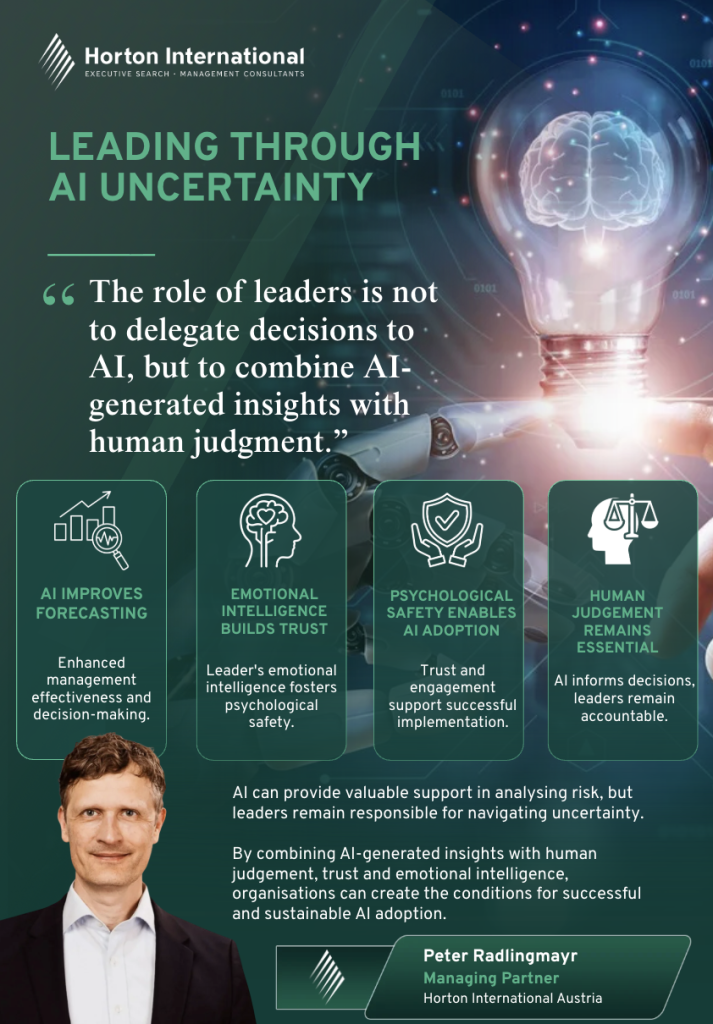
According to the psychologist Gerd Gigerenzer[3], leaders must distinguish between risk and genuine uncertainty. While AI can provide valuable support in analyzing known risks, human judgment, experience, and simple, robust decision-making heuristics remain indispensable under conditions of true uncertainty. The role of leaders is therefore not to delegate decisions to AI, but to combine AI-generated insights with human judgment. This can be done by
- balancing AI-generated insights with professional experience and expertise,
- maintaining accountability for decisions,
- recognizing, where human perspective remains essential.
In this regard, leaders have to take responsibility effectively. They must be trustworthy translators, enabling clarity about impacts, provide real empowerment, foster the importance of human judgement and where a human perspective remains essential, and show visible involvement. Ironically, the rise of AI demands more emotional intelligence amongst leaders.
Alwali & Alwali (2026) have pointed out – if investments in AI “are accompanied by leadership development programs that incorporate emotional intelligence and technological fluency […] This strategic alignment promotes psychological safety, enhances employee engagement and facilitates sustainable performance”[4]. By providing active conscious leadership with emotional intelligence, leaders can manage uncertainty caused by AI most effectively and make a difference.
Sources
[1] Vargas Portillo P. (2026), The transformative role of artificial intelligence in leadership and management development: an academic insight. Development and Learning in Organizations: An International Journal, 40(1), 1–4. doi: https://doi.org/10.1108/DLO-10-2024-0301
[2] Reich, A., Wolfe, D., Price, M.R., Choe, A., Kidd, F., & Wagner, H. (2026). Safety First: Psychological Safety as the Key to AI Transformation. ArXiv, abs/2602.23279.
[3] Gigerenzer, G. (2014). Risk Savvy: How to Make Good Decisions. Viking.
[4] Alwali J., Alwali W. (2026), Linking AI-driven HRM and emotional intelligence to leadership effectiveness and employee performance. Leadership & Organization Development Journal, 47(3), 477–497, doi: https://doi.org/10.1108/LODJ-05-2025-0358